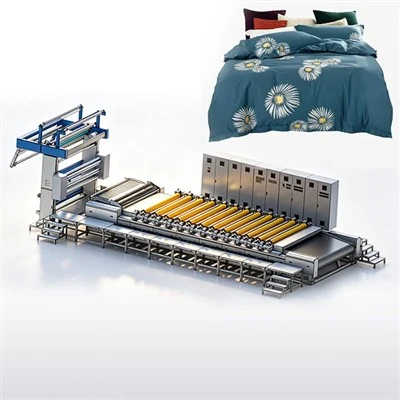
DGE provides Home Textiles Rotary Printing Machine and printing solutions to meet different production needs. DGE textile printing machines offer flexible, open‑chuck designs for quick screen changes, as well as high‑performance machines for large‑format print designs, ensuring your print quality, efficiency, and cost reduction.
Looking to expand your fabric production capacity? Or building a new printing & dyeing line?
Let us know, and we will provide you with a reliable, cost‑effective solution.
Home textile fabric machine selection
•Width: 2000mm – 3400mm
•Number of colors: 4–16
•Nickel screen repeat size: 640–2500mm (optional)
•Drying chamber: 3‑layer mesh belt with 3‑layer fabric threading, 5 sections;
5‑layer mesh belt with 5‑layer fabric threading, 7–8 sections
•Infeed frame: options for knitted fabric, woven fabric, or combination (knit/woven) infeed frame
•Applicable fabric weight: 100–800 g/m²
•Heating methods: natural gas / thermal oil / steam
Process flow

|
|
|


Details
 |
|
|
| Control System | Printing Unit | Drying Oven Unit |


Industry applications

Frequently Asked Questions (FAQ)
•What are the main advantages of rotary screen printing?
The main advantage is its extremely high production speed, making it the most cost‑effective method for producing patterned fabric in large volumes with consistent quality.
•How does rotary screen printing reduce production costs?
It reduces costs by significantly increasing production speed (lowering labor cost per metre of fabric) and by efficient ink utilization in continuous, long production runs. Although the initial investment is high, its unit cost advantage is outstanding in mass production.
•What types of fabrics can be printed with this method?
Rotary screen printing is very versatile and can be used on many fabric types, including cotton, polyester, blends, as well as various knitted and woven materials.
•What is the main difference between rotary screen printing and digital printing?
Rotary screen printing is suitable for large‑scale, repetitive patterns – low unit cost but high setup cost. Digital printing machine is more suitable for small batches, custom designs, and complex colors – no screen‑making cost but higher unit cost. Each has its advantages depending on production needs.
Why has DGE steadily progressed over 30 years of development?
Over the past three decades, DGE has been able to steadily grow and secure its market position through solid, step‑by‑step accumulation. In the 1990s, when China's textile equipment technology was relatively backward, our chairman made a special trip to Europe to study advanced technology from leading international brands.
After that, we joined forces with PhDs, masters, and research institutions from the Northwest Textile Institute to independently develop the independent drive system for rotary screen printing machines. Keeping pace with fabric industry trends, we continuously upgraded our rotary screen printing equipment. Leveraging our solid heavy‑machinery manufacturing expertise, we also developed digital printing machines and obtained multiple national patents.
Along the way, whether R&D engineers, frontline production staff, or overseas after‑sales teams, all have remained dedicated to their fields for over twenty years, constantly striving for excellence. And the recognition and trust of our customers have been the greatest confidence that keeps us moving forward.

Hot Tags: home textiles rotary printing machine, China home textiles rotary printing machine manufacturers, suppliers, factory, Fabric Nickel Screen Printer, Fabric Rotary Printing Equipment, Fabric Rotary Screen Printing Range, Home Textiles Nickel Screen Printing Machine, Multi Color Rotary Screen Printer, Rotary Printing Machine
Technical Specification
|
Name |
Home Textiles Rotary Printing Machine | ||||||||||||||
|
1.Printing unit |
|||||||||||||||
|
Model |
7280A(High Speed Type) |
||||||||||||||
|
Nominal width(cm) |
180 |
200 |
220 |
240 |
260 |
280 |
300 |
320 |
340 |
||||||
|
Effective printing width(cm) |
162 |
185 |
205 |
225 |
245 |
265 |
285 |
305 |
325 |
||||||
|
Standard colors |
4/6/8/10/12/14/16 |
||||||||||||||
|
Repeat size(mm) |
577,640,820,914,1018 |
||||||||||||||
|
Printing varieties |
Knitted fabric, woven fabric |
||||||||||||||
|
Printing speed |
4~ 100m/min |
||||||||||||||
|
Printing type |
magnetic type + scraper type(any combination) |
||||||||||||||
|
Alignment accuracy |
±0.1mm |
||||||||||||||
|
Transmission mode |
Guide belt drive: Physis servo motor |
||||||||||||||
|
Printing unit: Independently driven by Europe servo motor |
|||||||||||||||
|
Machine operation |
Left/right hand (It depends on actual use) |
||||||||||||||
|
2.Feeding cloth unit |
|||||||||||||||
|
Model |
T2181 |
T2280 |
T2381 |
T2480 |
H2181 |
H2280 |
|||||||||
|
Type |
woven fabric standard model |
woven and knitted fabric standard model |
woven and knitted fabric strengthen model |
knitted fabric dedicated model |
woven fabric constant speed print model |
woven knitted fabric standard model |
|||||||||
|
3.Dryer unit |
|
||||||||||||||
|
Model |
S3013 |
S3023 |
S3033 |
S3055 |
|||||||||||
|
Dryer sections |
4/5 |
5 |
4/5 |
7/8 |
|||||||||||
|
Applicable fabric |
woven fabric |
Double-sided penetrative wax printing on fabric |
knitted fabric |
Thick fabric |
|||||||||||
|
Speed |
5~100m/min(50HZ) |
||||||||||||||
|
Dryer temperature |
80℃~200℃ |
||||||||||||||
|
heat source |
Heat transfer oil/Steam/natural gas (standard: Heat transfer oil) |
||||||||||||||
|
4.Power configuration |
|||||||||||||||
|
Power supply |
AC3-380V±10﹪,50Hz |
||||||||||||||
|
Total power |
160 KW |
||||||||||||||
|
Compressed air |
0.6~0.8MPa |
||||||||||||||
|
Water source |
0.2~0.4MPa |
||||||||||||||
Contact us for professional technical solutions.
Email:master@xadegao.com
Tel:+86 18149064308(whatsapp/wechat)